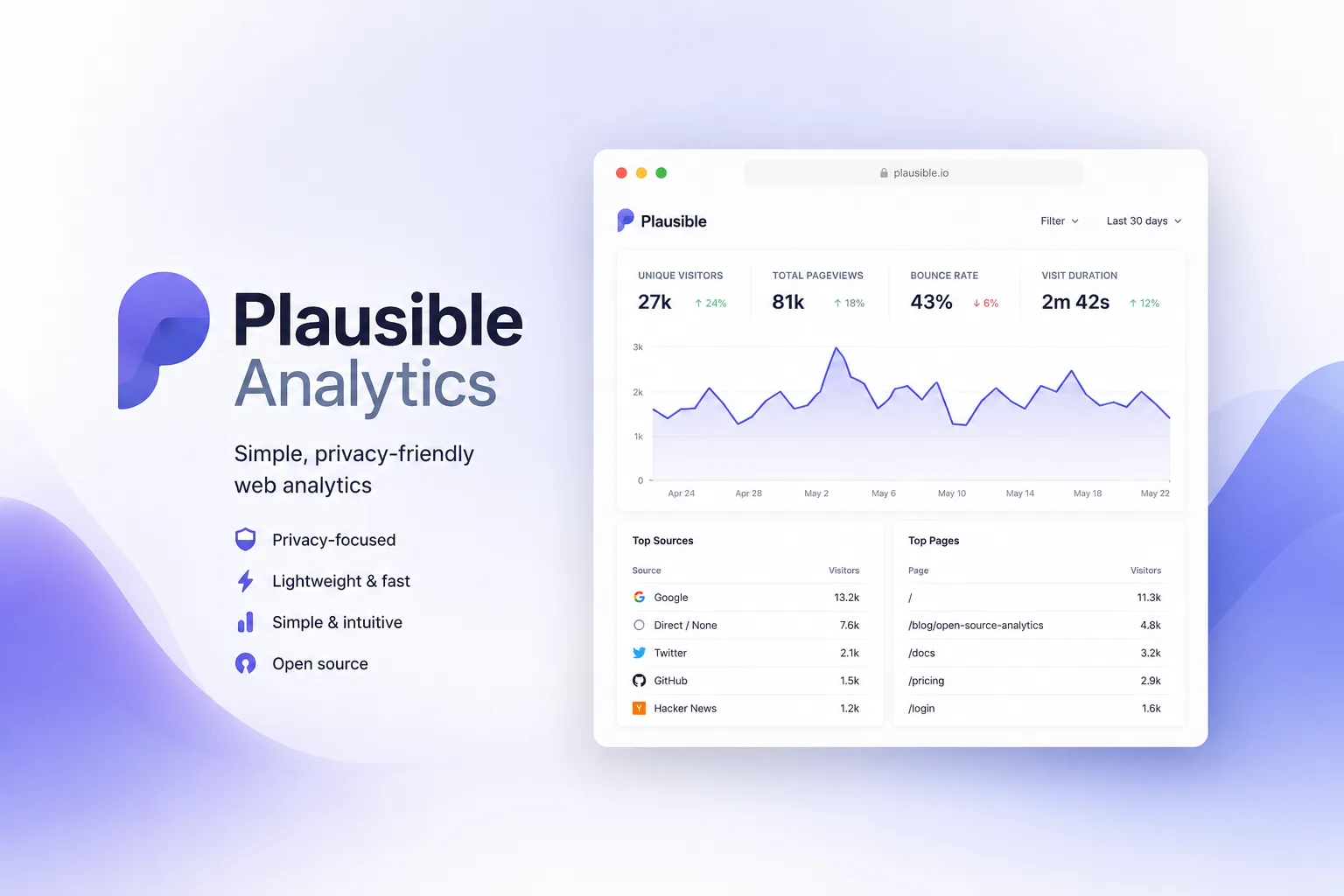
Plausible describes itself as “an open source, privacy-first web analytics tool. Lightweight, cookie-free alternative to Google Analytics. Available in managed cloud or self-hosted community edition.” It is AGPL-3.0 licensed.
If you intend to self-host it, there is a specific trap waiting for you, and it is a stale container image.
Pull the right image
The image many older guides reference is plausible/analytics on Docker Hub. We checked it: 8.15 million pulls, and last updated 12 July 2023.
The self-hosted product was renamed and moved. It is now Plausible Community Edition, it lives in its own repository (plausible/community-edition, separate from the main plausible/analytics source repo), and its images are published to GitHub’s registry:
ghcr.io/plausible/community-edition:v3.2.1There is a plausible/community-edition repository on Docker Hub too, but it was last updated in October 2024 and has only about forty thousand pulls — so it is not the live channel either.
The consequence is blunt: following a 2022 or 2023 tutorial gets you a three-year-old build, and you will spend an evening debugging problems that were fixed long ago. Check the registry hostname in any guide you follow. If it says Docker Hub, the guide is out of date.
Self-hosting it means running ClickHouse
The second thing to know before committing, taken from the Community Edition compose file:
plausible_db:        postgres:16-alpine
plausible_events_db: clickhouse/clickhouse-server:24.12-alpine
plausible:           ghcr.io/plausible/community-edition:v3.2.1
Three services. Postgres holds configuration and user data; ClickHouse holds the events.
That is the correct architecture — a column-oriented database is exactly right for “count pageviews grouped by path over a date range,” which is what analytics queries are — and it is also a heavier operational commitment than people expect from a tool whose selling point is being lightweight. The lightweight part is the tracking script, not the backend.
ClickHouse specifically wants attention on disk and memory. It is not a database you tuck into a 1 GB VPS alongside four other services and forget about. Size the host for it, and give the event-data volume room to grow.
The thing self-hosting gets you that Cloud does not
Most comparisons frame self-hosting as “the same product, you run it.” Plausible’s own comparison table names a difference that actually favours CE, and it is worth quoting:
“Do you want access to the raw data? Self-hosting gives you that option. You can take the data directly from the ClickHouse database.”
On Cloud, “You can only see the stats aggregated in the dashboard” — with CSV export, the stats API and a Looker Studio connector as the ways out. On CE, the events table is yours to query.
That is a genuine reason to self-host rather than an ideological one. If you want to join your analytics against your own application data, or run a query the dashboard does not offer, CE lets you write SQL against the events. Cloud does not.
The trade in the other direction is also stated plainly: Cloud processes all visitor data “exclusively on EU-owned cloud infrastructure” in Germany, which is a compliance position someone else maintains for you. With CE, as the table puts it, you can “host it on a server in your basement or host it with any cloud provider wherever you want, even those that are not GDPR compliant.” The control is yours and so is the responsibility.
Also noted in the comparison: the Looker Studio connector is not available on CE.
On the privacy claim
Cookie-free and GDPR-oriented analytics is the product’s core promise, and the lighter tracking script is the visible part of it. Two things are worth being precise about.
First, “privacy-first” describes the design, not an automatic legal conclusion for your deployment. Self-hosting means you are the data controller, and the consent question for your jurisdiction is yours to answer, not the software’s.
Second, the comparison worth running is against Umami, which occupies the same niche under an MIT licence and can also be configured with ClickHouse behind it. The practical differences come down to licence preference, the dashboard you prefer looking at, and whether you want the simpler Postgres-only deployment that Umami allows.
How to approach it
Use Cloud if the EU-processing position is what you want and you would rather not operate ClickHouse. Self-host if raw event access matters, or if you need the data on infrastructure you choose.
If you self-host: pull from ghcr.io, use the compose file from the community-edition repository rather than a blog post, size the host for ClickHouse, and back up both volumes — a platform like Coolify makes the three-service lifecycle manageable.
The finding: the self-hosted product is Plausible Community Edition, currently v3.2.1 on ghcr.io, while the Docker Hub image most guides still point at has not been rebuilt since July 2023. Self-hosting means Postgres plus ClickHouse plus the app, and the payoff for that work is direct SQL access to your raw events — which is the one capability Cloud does not offer.
Primary link
Learn more at: https://github.com/plausible/analytics