Polar has repositioned. Where it was known as billing infrastructure for developers selling software, its own headline now reads “A billing platform for the intelligence era,” describing itself as “the financial layer for a new generation of intelligent software” and aiming squarely at AI startups that need to charge for usage.
The product underneath is the same and the interesting fact about it has nothing to do with AI. It is three words: merchant of record.
What “we’re the merchant of record” actually buys
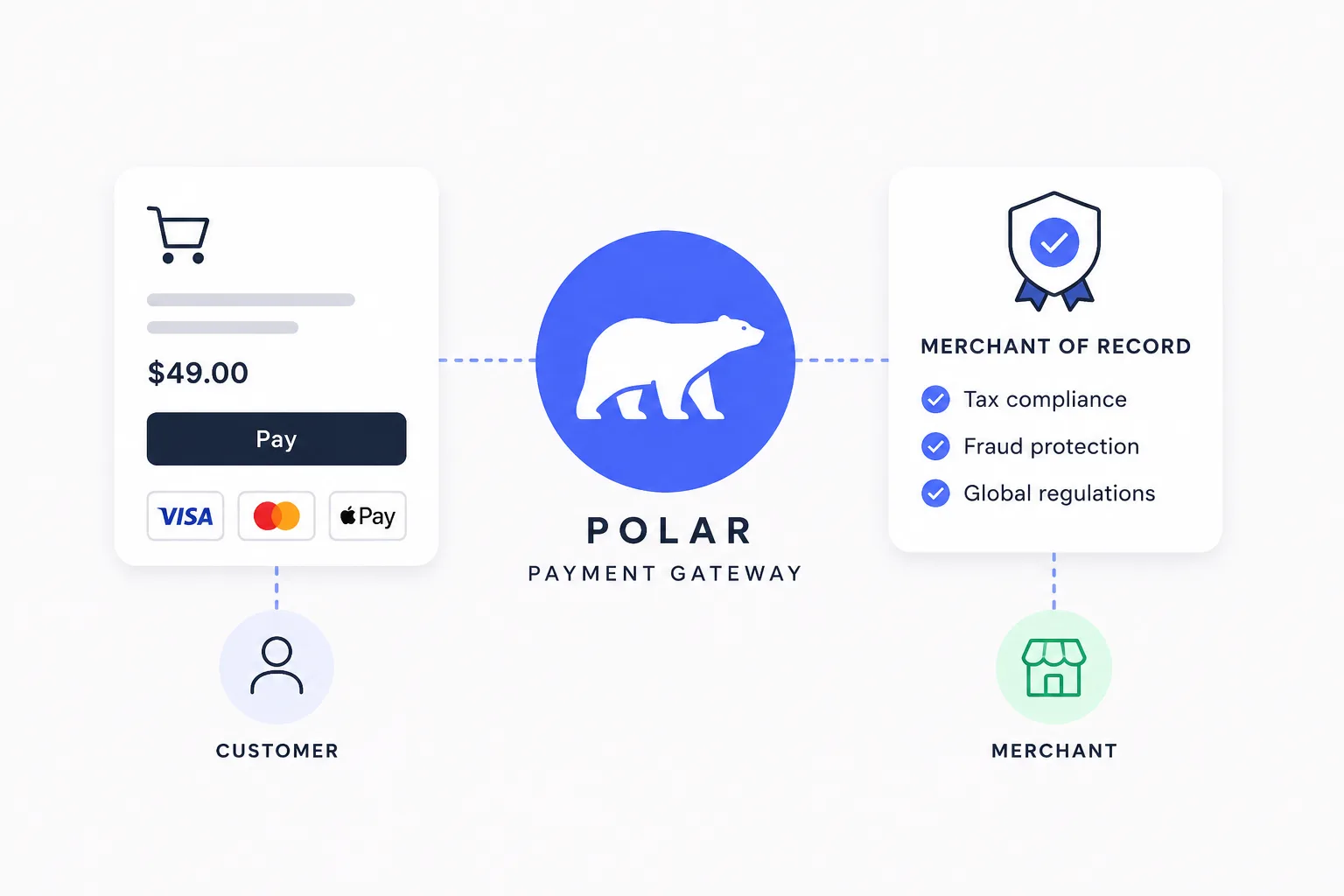
Polar’s statement is direct — “We’re the merchant of record” — and it handles “sales tax and VAT on the user’s behalf,” along with receipts, customer accounts and dunning.
That phrase is the entire value proposition and it is routinely glossed over, so here is what it means concretely. A merchant of record is the legal seller. The customer’s contract and card statement reference Polar, not you. Polar therefore owes the VAT in Germany, the sales tax in the applicable US states, the GST in Australia — and does the registrations, the thresholds, the filings and the remittance.
Compare that with taking payments directly through a payment processor. A processor moves money; it does not become the seller. The tax obligations stay with you, which for digital goods sold internationally means potentially registering for VAT in the EU, monitoring economic nexus thresholds across US states, and filing in each. This is the single largest hidden cost of selling software to individuals worldwide, and it is administrative rather than technical, which is why engineers consistently underestimate it.
So the question Polar answers is not “how do I take a card payment” — that is solved — but “who is responsible for the tax.” Transferring that responsibility is worth paying for, and the fee is how you pay for it.
The fees, and how to read them
As stated on the project’s own page:
| Plan | Fee |
|---|---|
| Starter (free) | 5.00% + 50¢ per transaction |
| Pro | 3.80% + 40¢ |
| Growth | 3.60% + 35¢ |
| Scale | 3.40% + 30¢ |
Eligible startups can apply to a Startup Program for a year on the most generous plan. The page notes additional fees may apply.
The right comparison is not against a bare payment processor’s rate, because that comparison is meaningless — you would be comparing a service that includes tax liability against one that does not. The honest comparison is: processor fees, plus an accountant for multi-jurisdiction registrations, plus your own time, against a single percentage.
Two observations on the numbers. The fixed component matters more than the percentage at small ticket sizes: 50¢ on a $5 sale is 10% before the percentage is applied, so low-price digital goods are where merchant-of-record pricing hurts. And the percentage steps down with volume, which means the arithmetic that rules Polar out at launch may favour it later, and vice versa.
The licence is Apache-2.0, and that does not mean what you might hope
Polar is “Licensed under Apache License, Version 2.0” — genuinely permissive, which is unusual for a payments company and worth acknowledging. You can read the whole system.
But note what the repository does not say: there is no statement about self-hosting anywhere on it. The only setup documentation is a DEVELOPMENT.md for standing up a development environment.
That absence is not an oversight, and it is worth being clear about why, because “Apache-2.0” invites the wrong conclusion. The licence covers the code. It cannot grant you the thing that makes Polar useful — being the legal seller of record in dozens of tax jurisdictions. You cannot self-host a tax entity. Running your own copy of the software would give you a billing application and leave every obligation exactly where it was.
So read the open licence as transparency and as insurance against the platform disappearing, not as a deployment option. That is still worth something: you can audit how your billing works, and your integration is against code you can read.
What it covers, and what to verify
The feature list as stated is “usage billing, subscriptions, seats, credits, trials, and discounts” — the modern SaaS set, with usage billing first, consistent with the AI-startup positioning.
Usage billing is the one to evaluate carefully, because it is the hardest to get right and the easiest to describe. The questions worth asking before committing: how are usage events ingested and at what rate, what happens to events that arrive late or duplicated, how are mid-cycle plan changes prorated against usage already recorded, and what does the customer see before the invoice lands. These are the details that determine whether metered billing is a feature or a support burden, and no landing page answers them. Test with your own event volumes.
One structural note: because Polar is the merchant of record, the customer relationship is partly Polar’s. Receipts, dunning emails and the name on the statement are theirs. For most developer tools that is a relief. For a business where the purchase experience is part of the brand, it is a trade-off to make deliberately.
Who should hand over the tax question
Independent developers and small teams selling software or AI products to individuals and small businesses internationally, who would rather pay a percentage than become experts in cross-border consumption tax. The fee is high relative to a raw processor and low relative to the alternative it replaces.
It fits poorly if your ticket sizes are very small, if you are already a company with a finance function handling VAT registrations, or if you need to own the end-to-end customer relationship.
For charging machines rather than people, the comparison is a different architecture entirely — Pay settles individual HTTP requests against a wallet, with no merchant, no account and no invoice. The dev-tools archive collects the rest of the tooling around shipping software independently.
The finding: Polar’s repositioning to “the intelligence era” is marketing; the substance is that it becomes the legal seller and takes on sales tax and VAT, which is what the 3.4–5% plus fixed fee is actually buying. Its Apache-2.0 licence makes the code auditable and does not make the service self-hostable, because the thing you are paying for is a tax position rather than software.
Primary link
Learn more at: https://polar.sh/