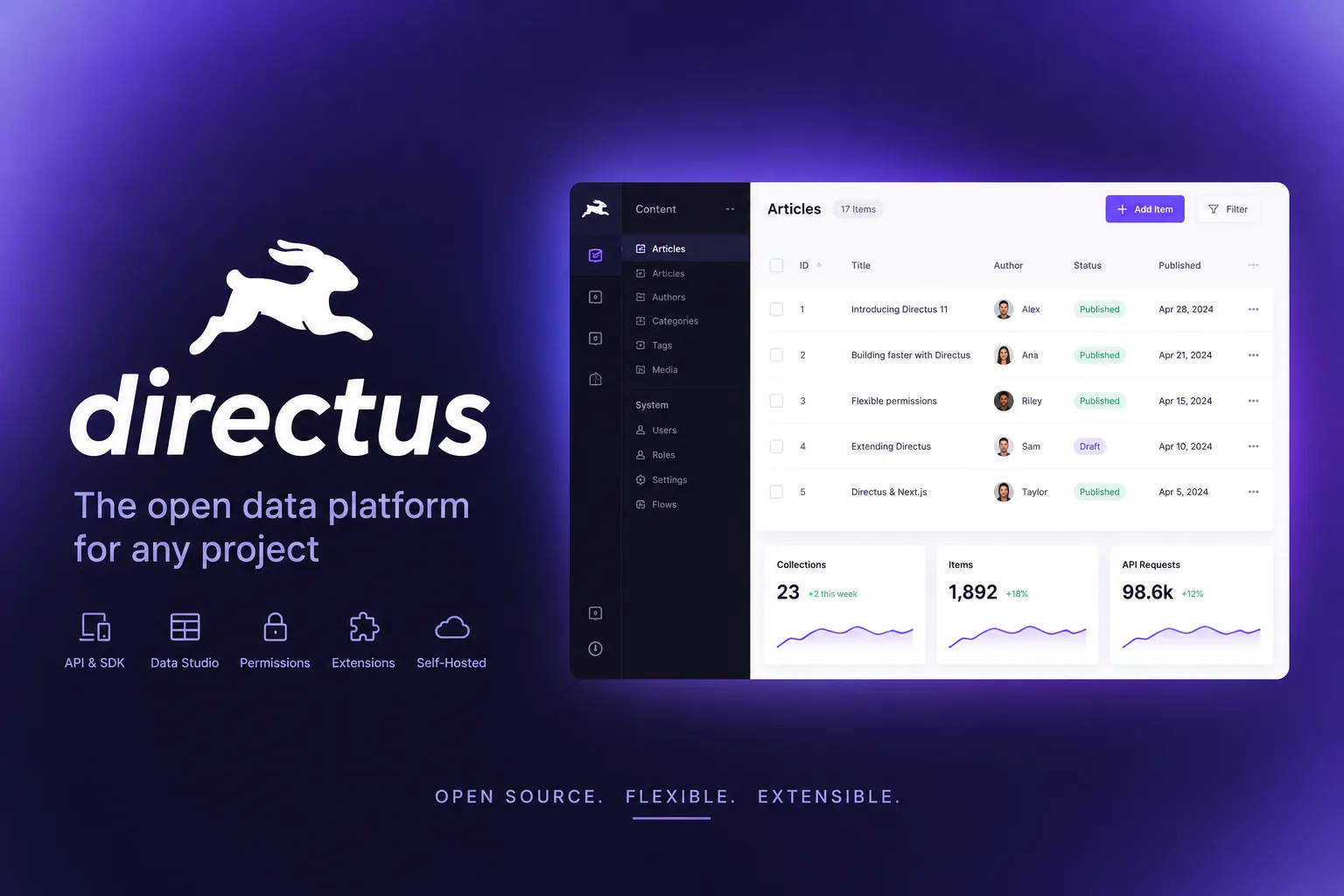
Directus is “a real-time API and App dashboard for managing SQL database content” — you point it at an existing SQL database and it gives you a REST and GraphQL API plus an admin app, without asking you to restructure your schema. That mechanism is as good as it ever was, and it is not what you need to check before adopting it.
What you need to check is the licence, because Directus is no longer open source, and the free tier now has hard numeric caps.
The licence, quoted
The npm manifest for directus (version 12.5.0 at the time of writing) does not declare an SPDX identifier. It says "SEE LICENSE IN license", which is the signal to go and read the file. It opens:
“# Monospace Sustainable Core License, Version 1.0”
“Copyright 2026 Monospace Inc.”
The licence grants broad rights — “use, copy, modify, create derivative works, publicly perform, publicly display and redistribute the Software” — but only “for any Permitted Purpose,” and that term is defined by exclusion:
“A Permitted Purpose is any purpose other than a Competing Use.”
“A Competing Use means making the Software available to any party (on a stand alone basis or together with your products or services) that competes with the Licensor’s commercial offerings of the Software itself, where Licensor imposes a license fee, royalty, or other charge for exercise of any rights to the Software.”
Permitted purposes are then listed explicitly: internal use and access; non-commercial education; non-commercial research; and professional services provided to someone who is themselves a licensee.
This is a source-available licence, not an open-source one. For the overwhelming majority of readers that distinction changes nothing — building your own product or internal tool on Directus is squarely an internal use. For anyone intending to offer Directus-as-a-service, or to bundle it into a product that competes with Directus Cloud, it changes everything.
The clause people will trip over
The Limitations section is short and specific:
“You must not move, change, disable or circumvent the license key functionality of the Software or modify any portion of the Software protected by the license key”
Read that carefully, because it tells you something the feature list does not: there is licence-key-gated functionality inside the codebase you self-host. Directus is not “free software with a paid cloud”; it is a product with commercial gating compiled in, and the licence makes removing that gating a licence violation rather than merely unsupported.
That is a legitimate business model and it is stated plainly. It is also the thing to know before you build on a feature and discover which side of the key it is on.
What the free tier actually allows
The pricing page makes the caps concrete, and self-hosting does not exempt you — the FAQ states: “Self-hosting is available on every tier.”
- Core — $0. Includes “3 user seats, 25 Collections, 5 Flows, AI Assistant, Advanced RBAC, Community Support.”
- Team — $499/mo (or $599 billed monthly), with additional seats at $50/seat/mo.
- Enterprise — custom.
- Grant — “Free for individuals and small organizations.”
Three seats and 25 collections is a real ceiling. A modest content model crosses 25 collections quickly, and three seats is one developer and two editors. The free tier is sized for evaluation and small projects, not for a team’s production CMS.
Also worth knowing: SSO is not available on Core at all, and cannot be added. The FAQ is unambiguous — “If SSO is a requirement, you need Team, Enterprise, or our Grant.”
The Grant tier is the genuinely generous part and the one most readers of this site should look at: free to self-host, aimed at individuals and small organisations. If you qualify, you get a different product than the Core caps suggest.
The engineering case is still strong
None of the above is an argument against the software, which remains unusually well-suited to one specific situation: you already have a SQL database with real data in it, and you want an API and an admin UI over the schema you have rather than one a tool invents.
Operationally it is a conventional deployment — the official image is 234 MB, last pushed in October, with a -dhi hardened variant alongside the standard tag, and the repository has 49.9 million pulls behind it. Version 12 is current. It runs the way any containerised app with a database behind it runs, which is to say Coolify or a compose file will do.
How to decide
Work out which tier you are in before you model your content, because 25 collections is a design constraint, not a billing detail. Check whether you qualify for the Grant. And if your use case is offering a hosted service to others, read the Competing Use definition with a lawyer rather than a blog post.
If the licence model is the blocker rather than the price, the alternatives differ in exactly that respect: Supabase assembles permissively licensed components around Postgres, and NocoDB — worth noting — is also source-available rather than open source, so it is not the escape hatch it might appear to be.
The finding: Directus’s own npm manifest declines to name an SPDX licence, and the file it points to is the Monospace Sustainable Core License, which bars competing use and forbids disabling the built-in licence key. Pair that with a $0 tier capped at 3 seats and 25 collections, and the question “is Directus free?” has a precise answer that depends entirely on your size and your intent.
Primary link
Learn more at: https://github.com/directus/directus