WordPress is one of the most consequential pieces of open-source software on the web: a publishing system, a content management platform, a developer ecosystem, and, for many site owners, the default mental model of what a website should be. The project’s GitHub organization presents the code side of that world: WordPress core mirrors, Gutenberg, WordPress Playground, performance work, Openverse, developer tooling, and newer experiments that show how broad the project has become.
The official WordPress story starts in 2003, when Mike Little and Matt Mullenweg forked b2/cafelog to continue the idea of a simple, elegant personal publishing tool. That origin still matters. WordPress did not begin as an enterprise CMS, a page builder, an ecommerce stack, or a no-code application platform. It began as software for people who wanted to publish. Its later dominance came from how effectively that publishing core absorbed themes, plugins, hosting, agencies, commerce, membership sites, media workflows, and developer customization without giving up its basic promise: ordinary people should be able to own and change their presence on the web.
Why WordPress became infrastructure, not just software
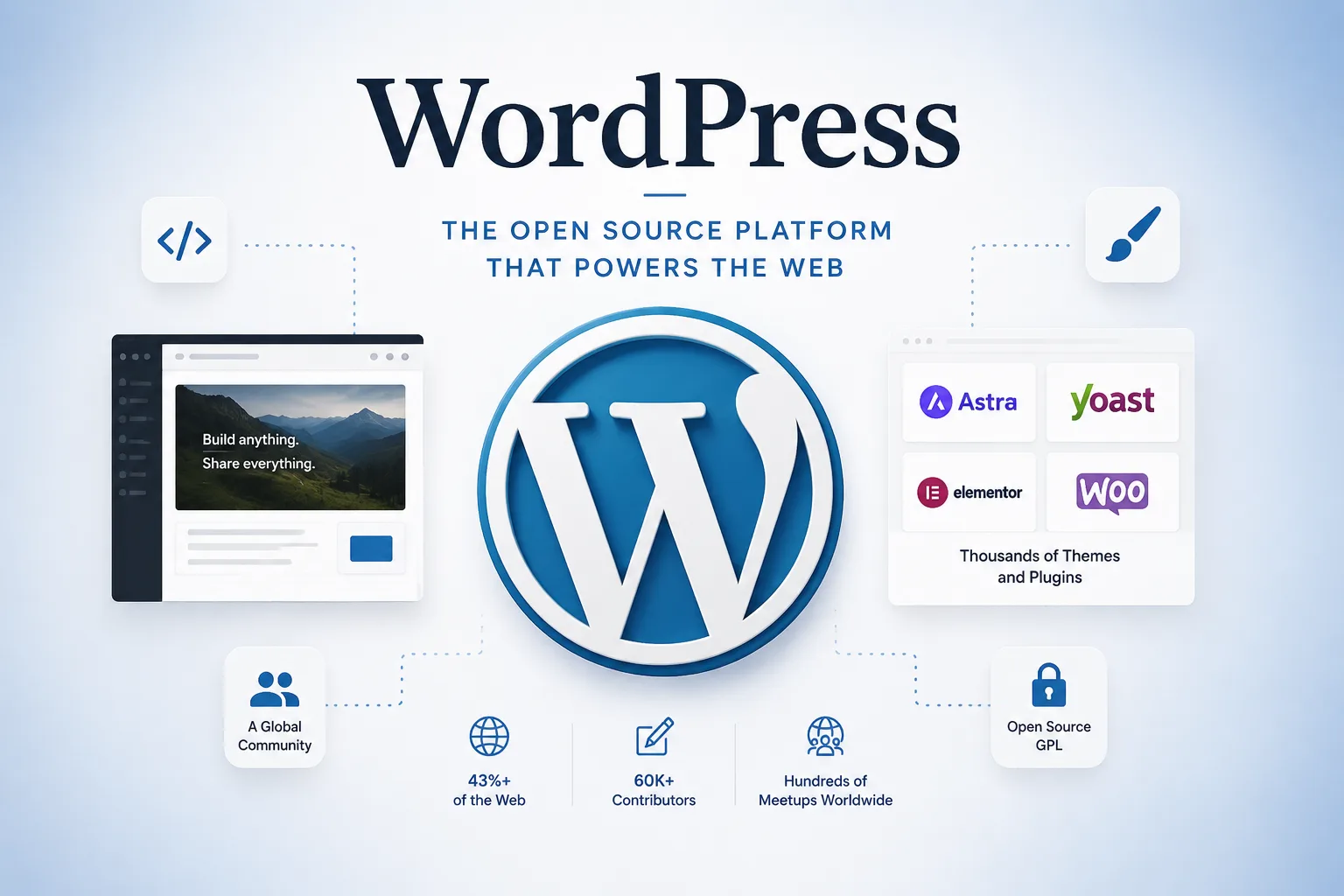
WordPress matters because it crossed a rare threshold. It is not merely a popular application; it became part of the web’s default infrastructure. W3Techs reported in May 2026 that WordPress was used by 41.9% of all websites and by 59.5% of websites whose content management system was known. WordPress.org’s own About page describes the platform as powering more than 43% of all sites across the web, which is broadly consistent with the long-running view that WordPress sits in a category of its own among content management systems.
That scale did not arrive from a single technical breakthrough. It came from a combination of timing, licensing, extensibility, hosting economics, and community habits. WordPress arrived when blogging was becoming mainstream, when shared PHP hosting was cheap, when MySQL-backed dynamic websites were becoming accessible to non-specialists, and when open-source web software could spread through one-click installers, forums, FTP tutorials, and local web agencies.
The project also benefited from being both simple and elastic. A user could start with a blog, change the theme, install a contact form, add analytics, add SEO controls, create custom post types, accept payments, and eventually run something that no longer looked like a blog at all. This made WordPress difficult to dislodge. Even when the interface felt dated or the codebase carried historical complexity, the installed base, developer knowledge, theme ecosystem, plugin market, hosting support, and migration familiarity reinforced one another.
The result was a flywheel. More users attracted more plugin authors. More plugins attracted more site builders. More site builders attracted more hosts and agencies. More agencies created more client sites. More client sites made WordPress the obvious skill to learn. By the time modern SaaS website builders matured, WordPress had already become the shared language of countless small businesses, publishers, nonprofits, creators, and independent developers.
From b2/cafelog fork to global project
The origin story is unusually important because it explains both WordPress’s strengths and its tensions. In 2003, WordPress was born as a fork of b2/cafelog. The project’s mission, as WordPress.org now phrases it, is to “democratize publishing,” and its official About page emphasizes freedom to build, change, and share. This was not simply a marketing slogan. It became a design constraint: WordPress had to be usable by people with limited technical experience while remaining open enough for developers to reshape.
The early WordPress formula was pragmatic. PHP and MySQL were everywhere. Themes separated presentation from content. Plugins let third parties add behavior without forking core. The admin interface made publishing feel approachable. The template hierarchy gave designers and developers a shared pattern for building sites. Permalinks, comments, categories, tags, RSS, and later custom post types turned WordPress into a publishing workbench that could grow with a site.
Leadership was another defining factor. Matt Mullenweg, as co-founder and later as the central public figure around WordPress, Automattic, WordPress.com, and WordPress.org, has played a role that is unusually visible for a project of this size. WordPress is open source and community-driven, but it has never been leaderless. Direction has often emerged from a mix of core contributors, release leads, Make WordPress teams, Automattic-sponsored work, WordCamps, hosting companies, plugin businesses, and Mullenweg’s long-term product instincts.
That leadership model has advantages. It gives WordPress continuity and a coherent philosophy over decades. It also creates recurring questions about governance, influence, trademarks, commercial interests, and how much control should sit with a small number of individuals or companies. Those questions became especially visible during recent disputes in the WordPress ecosystem, including public conflict involving Automattic, WordPress.org access, and WP Engine. The practical lesson is not that WordPress lacks a community. It is that a community at this scale needs governance clarity as much as code.
The project’s release culture also carries symbolic weight. Major WordPress releases are famously named after jazz musicians, and WordPress.org’s history page lists release names and dates as part of the project’s public memory. That ritual signals continuity: WordPress sees itself not as a short-cycle SaaS product but as a living open-source institution.
The GPL ecosystem and the abundance of themes and plugins
The most important business decision in WordPress history may be the one that is not a business model at all: licensing under the GNU General Public License. WordPress.org states that WordPress is released under GPLv2 or later, and that the project considers derivative works such as plugins and themes to inherit the GPL license. The site acknowledges legal grey areas, but the practical norm is clear: the official ecosystem is built around GPL-compatible distribution and the freedoms to run, study, modify, redistribute, and share modified versions.
That licensing framework made WordPress more than downloadable software. It made it a platform for derivative creativity. A theme could change the visual identity of a site. A plugin could add ecommerce, forms, caching, memberships, multilingual publishing, SEO controls, analytics, security hardening, image optimization, booking systems, learning management, communities, and almost any niche workflow a small business might need.
The official directories show the scale. WordPress.org’s plugin directory says users can browse over 63,000 free plugins. The theme directory describes over 14,000 free themes, with filters for layouts, block themes, ecommerce, education, portfolios, accessibility readiness, translation support, and more. Around those official directories sits a larger commercial market: premium themes, paid plugins, agencies, hosting bundles, maintenance services, GPL redistribution clubs, marketplaces, and custom development shops.
This abundance explains why WordPress won so many decisions at the margin. A restaurant owner did not need to commission an entire website system from scratch. A local agency could assemble a professional site from a theme, a booking plugin, a form plugin, caching, backups, and managed hosting. A publisher could add editorial workflows, ad management, and newsletters. A shop could install WooCommerce and grow into a serious ecommerce operation. Developers could write custom code only where the off-the-shelf ecosystem stopped.
The downside is that abundance also creates risk. Quality varies. Plugins can overlap, conflict, or become abandoned. A theme can lock content into shortcodes or builder-specific structures. A site can become slow because too many extensions load assets on every page. Security vulnerabilities often enter through plugins and themes rather than core. The GPL gives users freedom, but freedom does not automatically create coherent architecture, careful maintenance, or responsible update habits.
Still, the plugin-and-theme economy remains WordPress’s strongest moat. Competitors can build cleaner editing interfaces or more integrated hosting. Few can reproduce two decades of edge-case solutions created by a global extension market.
How WordPress came to power so much of the web
WordPress became dominant because it matched the economic reality of website creation. Most websites are not venture-scale software products. They are business cards, blogs, magazines, campaign sites, portfolios, documentation hubs, churches, clubs, schools, restaurants, product catalogs, local services, and ecommerce experiments. These sites need affordability, familiarity, hosting availability, visual customization, SEO basics, forms, media handling, user roles, and an upgrade path when needs become more complex.
WordPress met that demand better than almost anything else. It could be installed on inexpensive hosting. It had a huge search footprint of tutorials and answers. It was easy for freelancers to learn. It gave clients a dashboard. It allowed agencies to reuse patterns. It gave hosting companies a product to optimize. It let commercial vendors sell plugins and themes while keeping the underlying platform open. It made migration between hosts possible in a way that proprietary builders often did not.
The platform also benefited from compatibility with the web’s incremental nature. A WordPress site could be messy and still useful. It could start as a blog and later become a magazine. It could use a classic theme, then a block theme. It could run custom PHP, a page builder, WooCommerce, a headless frontend, or a hybrid setup. This tolerance for imperfection is not elegant in a computer-science sense, but it is powerful in the real world.
The block editor, known through the Gutenberg project, was WordPress’s most ambitious attempt to modernize the authoring experience. Gutenberg moved WordPress away from a single large text box and toward structured content blocks. The project’s GitHub description calls it “The Block Editor project for WordPress and beyond,” which is a good summary of its ambition: not just a new editor, but a foundation for page building, full-site editing, patterns, reusable components, and future collaboration workflows.
Gutenberg also illustrates the cost of changing a platform with a vast installed base. Every major shift has to account for old themes, old plugins, agency workflows, accessibility concerns, publisher habits, training materials, and millions of sites whose owners do not think of themselves as software maintainers. WordPress can move, but it cannot move like a greenfield SaaS editor.
Leadership, community, and commercial gravity
WordPress’s leadership story is inseparable from Automattic, WordPress.com, the WordPress Foundation, WordPress.org, and the wider contributor ecosystem. This is a strength and a source of tension. Automattic has funded major development, employed influential contributors, and built commercial products around WordPress. At the same time, independent hosts, plugin companies, agencies, volunteers, and enterprise users also depend on the project’s neutrality and predictability.
The Make WordPress system, core meetings, release teams, WordCamps, contributor days, and Five for the Future program all point to a decentralized contributor culture. Anyone can participate in many discussions, and WordPress has built an enormous social infrastructure around contribution. That social infrastructure is part of the product. WordPress is not just code downloaded from GitHub; it is documentation, translation, support forums, meetups, events, handbooks, review teams, accessibility work, security processes, and compatibility expectations.
Yet the ecosystem’s commercial gravity is real. WordPress is free software, but WordPress businesses are not small. Hosting, managed updates, premium plugins, themes, page builders, WooCommerce extensions, security tools, performance services, SEO products, and agencies all have revenue tied to the platform. This creates a constant negotiation between open-source ideals and business incentives.
The recent public disputes around WordPress governance and ecosystem contribution show that dominance brings institutional strain. When a platform powers a large share of the web, questions about who controls infrastructure, who contributes back, who can use trademarks, and who gets access to distribution channels become more than community drama. They affect livelihoods and operational risk for site owners and developers.
A mature WordPress needs both visionary leadership and trust-preserving governance. The project’s next decade may depend less on whether it can add another editor feature and more on whether contributors, companies, and users believe the commons remains stable enough to build on.
The AI-agent challenge
The biggest strategic challenge for WordPress is that the web is moving from human-operated publishing tools toward agent-assisted and agent-driven workflows. WordPress was designed around a human editor: log in, choose a post or page, write, add blocks, preview, publish, update plugins, manage media, adjust settings, and visually inspect the result. That model still works for millions of people. It is also increasingly mismatched with how AI systems are beginning to create, update, test, translate, summarize, restructure, and distribute content.
An AI-agent-first CMS would expose content models, permissions, workflows, components, media operations, revision history, semantic metadata, design constraints, and deployment actions in ways that are safe for machines to reason about. It would not simply add a chat box inside the editor. It would treat the site as an addressable system: create this landing page, reuse this brand pattern, update these outdated posts, convert this pricing page, generate alt text, check broken links, open a draft for approval, compare revisions, and publish only after policy checks pass.
WordPress has pieces of this future. Its REST API, block structure, custom post types, roles, revisions, plugin hooks, and media library already give developers many integration points. The Gutenberg project has pushed content toward structured blocks. WordPress Playground shows how WordPress can run in the browser through WebAssembly PHP, which opens interesting testing and demo workflows. The WordPress GitHub organization also now includes work explicitly aimed at AI coding assistants, including an agent-skills repository described as expert-level WordPress knowledge for AI coding assistants.
But the center of gravity remains human-editor-first. The admin dashboard, plugin settings pages, theme customization, page builder interfaces, and many editorial workflows assume a person clicking through screens. Even when AI plugins generate text or layouts, the deeper system often remains a collection of human-facing forms, legacy option pages, and plugin-specific abstractions. That makes WordPress powerful but uneven for agents.
This is where newer platforms can attack. A modern AI-native CMS can start with typed schemas, APIs, structured components, command surfaces, permissions, and automation logs. It can assume that agents will create drafts, inspect state, call tools, and coordinate deployment. WordPress can get there, but it has to modernize without breaking the ecosystem that made it dominant.
Practical adoption notes for today
For new projects, WordPress remains a rational choice when ownership, ecosystem depth, editorial familiarity, and broad hosting support matter. It is especially strong for content-heavy sites, small business sites, publisher workflows, membership projects, local commerce, marketing pages, and cases where a client needs a dashboard that many professionals already understand.
The best WordPress projects tend to be deliberate about scope. They choose a small number of well-maintained plugins instead of installing overlapping tools. They prefer themes and blocks that keep content portable. They plan updates, backups, caching, security monitoring, and staging from the beginning. They avoid treating the plugin directory as an unlimited parts bin. They document which plugin owns which business function.
For developers, the GitHub organization is useful but slightly misleading if read as the whole project. The WordPress core development process historically spans Subversion, Trac, Make WordPress blogs, Slack, GitHub mirrors, Gutenberg repositories, handbooks, and release channels. A contributor or technical evaluator should follow the official project process rather than assuming every decision happens through GitHub pull requests.
For organizations thinking about AI workflows, WordPress can already be part of an agentic stack, but usually with custom glue. A practical approach is to define safe boundaries: agents can draft content, classify posts, propose metadata, generate summaries, check links, or prepare translations, while publishing and plugin changes remain human-approved. Deeper automation should use APIs, staging environments, audit logs, and role-based permissions rather than browser-driving the admin interface.
For site owners, the strategic question is not “WordPress or AI.” It is whether the current WordPress implementation can expose enough structured state for the next generation of tools. Sites built with clean content models, fewer proprietary builder lock-ins, sensible custom post types, and well-documented workflows will adapt more easily than sites assembled from many opaque shortcodes and settings panels.
Trade-offs and caveats
WordPress’s greatest strength is also its greatest weakness: it is a platform for almost everything. That breadth makes it useful, but it also means there is no single WordPress experience. A clean block-theme site and a ten-year-old site with a heavy page builder, abandoned plugins, custom PHP snippets, and unmanaged hosting are both “WordPress,” but their maintainability is completely different.
Performance depends heavily on choices. Core WordPress can be efficient, but real sites often accumulate slow themes, large plugins, unoptimized images, render-blocking scripts, bloated builders, and database clutter. Security follows the same pattern. WordPress core has a mature security process, but the ecosystem’s size means site owners must treat updates, plugin selection, backups, least-privilege access, and monitoring as operational responsibilities.
The GPL ecosystem can also be misunderstood. GPL freedoms permit redistribution and modification, but that does not mean every redistributed plugin package is trustworthy, updated, supported, or safe to install. Commercial vendors often sell support, updates, cloud services, templates, or convenience around GPL code. Site owners need to understand the difference between license rights and operational reliability.
Governance remains another caveat. WordPress is too important to be treated as a hobby project, yet it is not governed like a conventional standards body or a single-vendor SaaS. Its power comes from a mixture of community, founder influence, foundation structures, Automattic investment, and commercial ecosystem pressure. That mixture has worked for a long time, but recent conflicts show that users and businesses increasingly want clearer expectations.
Finally, the AI shift is not cosmetic. Adding AI writing tools to the editor will not be enough. The deeper question is whether WordPress can become legible and controllable for agents without sacrificing the human-first publishing values that made it successful. That will require APIs, schemas, permissions, workflow primitives, testing environments, and project-level conventions that are more coherent than the average plugin-stacked site today.
Editorial verdict
WordPress is still one of the most impressive open-source success stories in software history. It turned a blogging fork into a global publishing platform, built a plugin and theme economy around the GPL, gave millions of people practical control over websites, and created a professional ecosystem that spans freelancers, agencies, hosts, enterprises, educators, and product companies.
Its power came from being approachable rather than pure, extensible rather than tightly controlled, and open rather than vertically integrated. Those same traits now create friction. WordPress has to modernize for structured content, collaboration, performance, governance clarity, and AI-agent workflows while preserving backward compatibility and the trust of an enormous installed base.
The platform should not be underestimated. WordPress has survived several waves that were supposed to replace it: hosted blog networks, social platforms, static-site generators, proprietary website builders, headless CMSs, page-builder wars, and SaaS ecommerce. Its ecosystem is messy, but it is also adaptive.
The real risk is not that WordPress disappears. The risk is that the most innovative new web workflows happen around it rather than inside it. If WordPress can make its content, design systems, permissions, and operational state more agent-readable while keeping its open publishing mission intact, it can remain central to the web’s next phase. If it stays primarily a human dashboard surrounded by plugin islands, it may continue to power a large share of existing sites while losing influence over how new web systems are imagined.
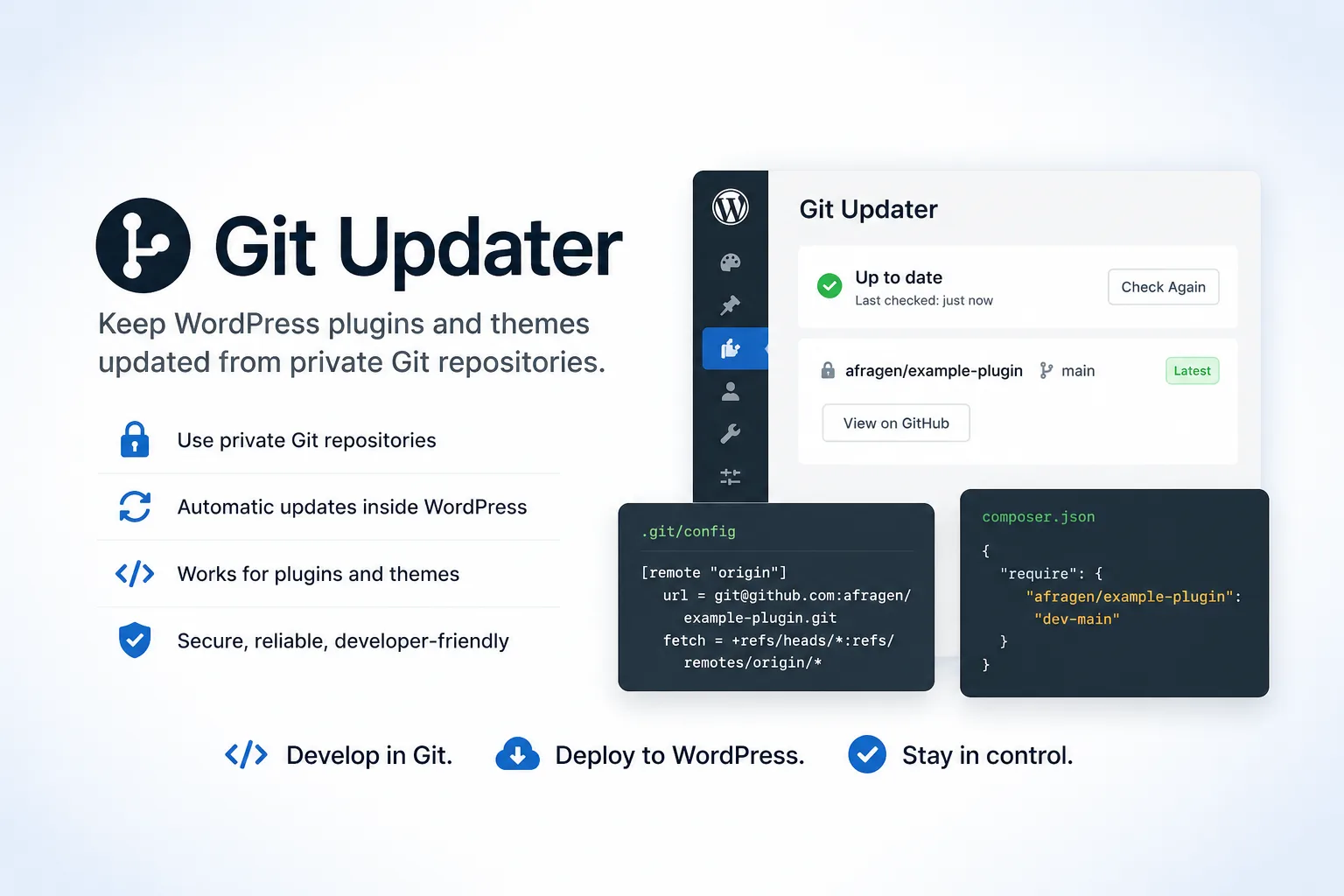
For related publishing coverage on Synopolis, see Git Updater for Git-hosted WordPress plugin updates, and Astro or TinaCMS for the static, Git-native side of the publishing spectrum.
Primary link
Learn more at: https://github.com/WordPress