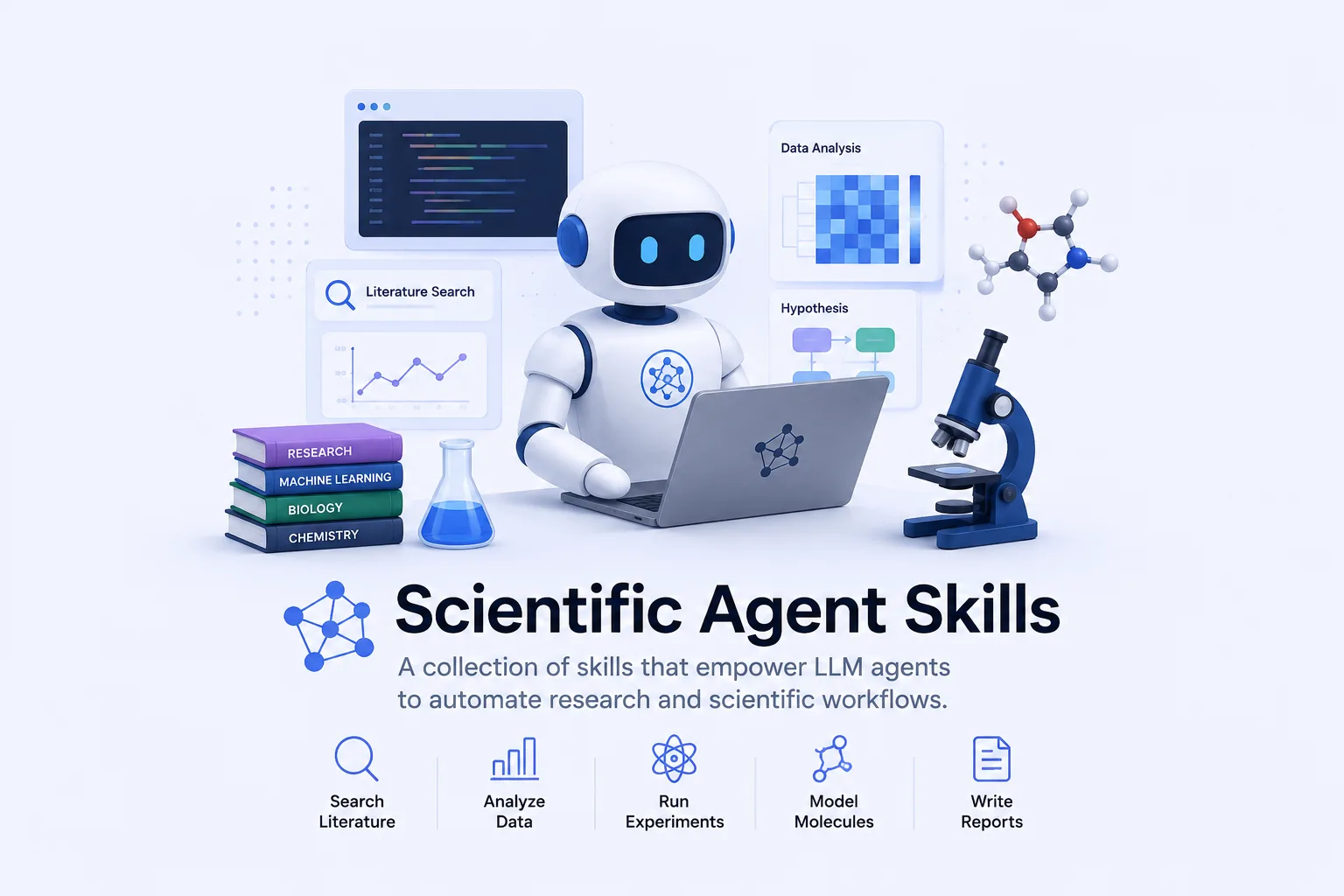
Scientific Agent Skills is a library of procedural knowledge for research agents — skills covering genomics, cheminformatics, medical imaging, study design and scientific communication, each carrying “the scientific conventions and validation checks needed” to use a particular package or data source. It is MIT licensed, at version 2.72.0, and it has an arXiv paper behind it (arXiv:2609.00065).
It also contains the clearest statement we have seen of a problem the whole agent-skills category has, and that statement is in the citation file.
The reproducibility problem, in the project’s own words
The repository ships a CITATION.cff. Its message field reads:
“If you use Scientific Agent Skills in your research or project, please cite the paper listed under preferred-citation. To pin the exact skill set an analysis ran against, also cite this repository and record the release tag or commit you used.”
That second sentence is the important one, and it deserves unpacking because it applies far beyond this project.
A skill is procedural knowledge: it tells an agent how to run an analysis, which conventions to follow, which validation checks to apply. If the skill changes, the analysis changes. So an agent-assisted result is only reproducible if you know which version of the skill produced it — and a repository at version 2.72.0 has changed a great deal.
Most skill libraries say nothing about this. This one puts it in the file that researchers are expected to read when citing, and names the mechanism: record the tag or the commit.
If you do computational research with agent assistance, adopt that practice regardless of which library you use. “We used Claude with the genomics skills” is not a method. “We used scientific-agent-skills at tag v2.72.0” is.
A counting discrepancy in the citable metadata
Since the project invites citation, we checked the numbers it publishes about itself.
The README badge says 177 skills. The README prose says “a collection of 177 scientific and research skills.” Counting directories under skills/ on a fresh clone gives 177. Three independent sources agree, which is a better result than most repositories of this size manage.
The CITATION.cff abstract, however, describes “an open library of 163 ready-to-use Agent Skills.”
A fourteen-skill gap, and it is in the one file whose purpose is to be machine-read and copied into bibliographies. This is trivial to fix and worth reporting precisely because of where it sits: the citable metadata understates the library, so a paper citing it inherits a stale figure. If you cite this repository, take the count from the repository rather than from the abstract.
What is actually in the repository
The file census tells you this is not a collection of prompt snippets:
- 2,025 files under
skills/ - 370 files under
tests/ - 362 files under
docs/ - A
scan_skills.pyat the root, with a security-scan workflow and a skill-tests workflow both reporting status in the README
Tests for skills is the part worth noting. A skill is prose instructions, which makes it the kind of artefact nobody normally tests — and the kind most likely to drift into being wrong. A test suite plus CI around a prose library is unusual diligence, and alongside the 100+ scientific databases the project claims to cover, it is the main reason to take this more seriously than a curated list of prompts.
There is also a pyproject.toml and a plugin.json, so the library is packaged both as a Python project and as an agent plugin.
The rename, and what it signals
A notice near the top of the README:
“Claude Scientific Skills is now Scientific Agent Skills. Same skills, broader compatibility — now works with any AI agent that supports the open Agent Skills standard, not just Claude.”
Worth knowing for two reasons. If you bookmarked the old name, this is the same project. And the direction of travel is toward a portable standard rather than one vendor’s format — the badges name Cursor, Claude Code, Codex and Google Antigravity as supported, which is what a standard being adopted looks like rather than claimed.
That portability is the same argument made by the convention this category is built on, which our review of AGENTS.md covers: instructions that work across agents outlive the agent you happen to use today.
Who should use it, and how
Researchers and research engineers doing computational work in the covered domains, who want an agent to follow their field’s conventions rather than invent plausible-looking ones. The validation checks are the real value — the failure mode of an agent doing genomics is not a crash, it is a result that looks right.
Three practical suggestions:
Install selectively. 177 skills is a large catalogue, and a catalogue advertised to a model consumes context. Take the domains you work in.
Pin the tag. Per the project’s own instruction, and record it in your methods.
Verify the validation, not just the output. A skill encoding your field’s conventions is only as good as whether those conventions are the ones your reviewers expect. Read the skill for the analysis you care about before trusting it. If you want the general pattern for how such skills are written, Anthropic’s own skills repository is the shorter reference.
The finding: the project tells you to cite a release tag so an analysis can be reproduced against the exact skills that ran it — which is the single most useful idea in the agent-skills category and is almost never stated. Its skill count of 177 is consistent across badge, prose and a clone, while the CITATION.cff abstract still says 163, so take the number from the repository.
Primary link
Learn more at: https://github.com/K-Dense-AI/scientific-agent-skills