Awesome Security is a community-driven GitHub collection of security software, libraries, documents, books, and related resources. The repository describes its goal as building a categorized collection of well-known resources, and its README is organized around practical security domains rather than a single product workflow.
That makes the project useful less as a tool to install and more as a map of the security landscape. Readers can scan from network discovery and intrusion detection to web application testing, SIEM, operating-system privacy tools, DevOps security, and incident-response-adjacent resources.
Why a curated security map still matters
Security teams and independent builders often face the same problem: the ecosystem is too large to evaluate from memory. A flat web search for “security tools” can mix serious projects with abandoned scripts, marketing pages, and narrow one-off utilities.
Awesome Security is valuable because it gathers recognizable names into sections that match real work: scanning, monitoring, IDS and IPS, packet capture, VPN, firewalls, anti-spam, web application security, DevOps, operating systems, and more. The result is not a replacement for documentation or threat modeling, but it is a practical starting point for discovery.
Security tools readers will recognize immediately
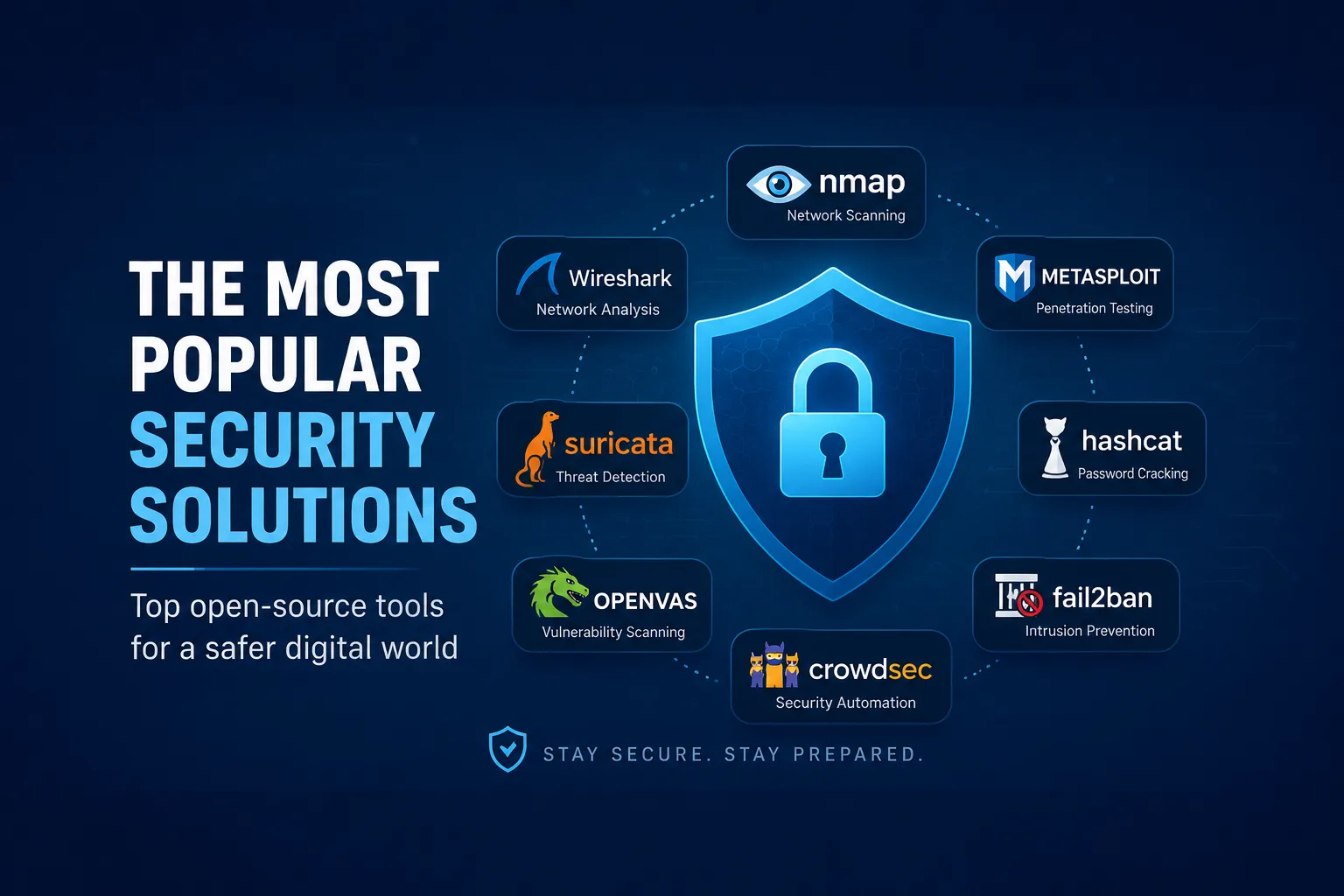
The README includes many tools that experienced security practitioners will already know. Calling them out helps a reader see the practical weight of the collection quickly:
- Nmap for network discovery and security auditing.
- Metasploit Framework for exploit development and execution workflows.
- Kali Linux as a penetration-testing and digital-forensics Linux distribution.
- Wireshark for packet analysis and network troubleshooting.
- Wazuh for threat prevention, detection, response, and SIEM-style monitoring.
- Snort, Zeek, Suricata, and Security Onion around intrusion detection, network security monitoring, and log management.
- pfSense and OPNsense for firewall and routing use cases.
- ModSecurity, BunkerWeb, NAXSI, and open-appsec in the web application firewall section.
- OWASP ZAP and sqlmap for web application testing.
- Trivy for container and artifact vulnerability scanning in DevOps workflows.
Those names should make a reader pause because they cover different layers of a defensive stack: discovery, testing, monitoring, detection, firewalling, web protection, and CI security.
What the collection covers in practice
The repository is broad by design. It includes network security resources for scanning, monitoring, packet capture, SIEM, VPNs, firewalls, anti-spam, and Docker images for penetration testing and security labs.
It also moves into endpoint and host-oriented topics, threat intelligence, social engineering, web application security, red-team infrastructure, exploits and payloads, DevOps security, secure operating systems, ebooks, and links to other awesome lists. That breadth is useful when the reader is building a checklist, comparing categories, or trying to find adjacent areas they have not reviewed yet.
Best-fit scenarios
Awesome Security fits readers who need orientation before deeper evaluation. It is especially useful for security engineers building a personal toolbox, developers adding DevSecOps checks, homelab users exploring defensive tooling, and editorial or research teams assembling a landscape overview.
It also works well for people who already know one tool but need category neighbors. For example, someone familiar with Nmap may use the list to find related reconnaissance tools; someone using Wazuh may scan the SIEM and monitoring sections; someone focused on web security may jump to ModSecurity, ZAP, sqlmap, and OWASP resources.
Adoption notes for teams and individuals
Treat this repository as a curated index, not as an implementation guide. Each listed project should still be checked on its own site or repository for maintenance status, release cadence, license, deployment model, security advisories, and operational requirements.
For teams, a practical approach is to shortlist tools by category, then evaluate only a small number at a time. A network monitoring candidate, a vulnerability scanner, and a WAF do different jobs; comparing them as if they were substitutes would create confusion. The list is strongest when used to structure research, not to skip it.
Caveats and limits
The repository does not promise that every listed tool is current, maintained, production-ready, or suitable for a particular regulatory environment. Some entries are learning resources, some are offensive-security tools, some are defensive platforms, and some are specialized utilities.
Because it is a community-driven list, readers should also watch for overlap and uneven depth. Well-known entries such as Nmap, Wireshark, Wazuh, Snort, Zeek, Suricata, Metasploit, Kali, ZAP, Trivy, pfSense, and OPNsense stand out, but popularity should not be treated as a security guarantee.
Editorial verdict
Awesome Security is a useful orientation layer for the security ecosystem. Its strength is breadth: it helps readers spot major categories and recognizable projects quickly, then decide where deeper research is needed.
The best way to use it is as a launchpad. Pay attention to the major tools named above, but verify each project against your own environment, risk model, licensing needs, and maintenance expectations before adopting it.
For hands-on security and resilience tooling covered on Synopolis, see Vaultwarden for self-hosted password management and Kopia for encrypted backups.
Primary link
Learn more at: https://github.com/sbilly/awesome-security